Project
N°001
Name
01 Cellular Automata Practice Frame
Location
Fretboard
Year
2026
Type
Breadcrumb 01
Mode
Hypothesis
Author(s)
Sandeep Ramesh & Glider (SR's Guitar AI Agent)
SPEED READ. Guitar practice reframed as a cellular automaton. One seed (a specific, playable 2-4 bar fragment chosen by resonance, not obligation), seven simple operations (transpose, shift a note, displace rhythm, change tempo, alweter harmonic context, reverse contour, truncate/extend), repeated indefinitely. Core thesis: complex musicianship emerges from local rules and honest iteration, not from curricula or master plans. Mastery is note-by-note (Werner: let two notes flow before adding a third). Constraints: 20 min sessions, honest reps only, weekly time box (prevents perfectionist drift and overreach alike). First seed: Paganini Caprice No. 2 ending bars (Oparin transcription). There is no final generation. The pattern runs.
And so, I begin again.
In 1970, the mathematician John Conway invented the Game of Life: a grid of cells, each either alive or dead, governed by four rules about how neighbors affect each other. No central controller. No blueprint. Just a seed state and a handful of operations. From these, astonishing complexity emerges: gliders, oscillators, structures that propagate and self-replicate.
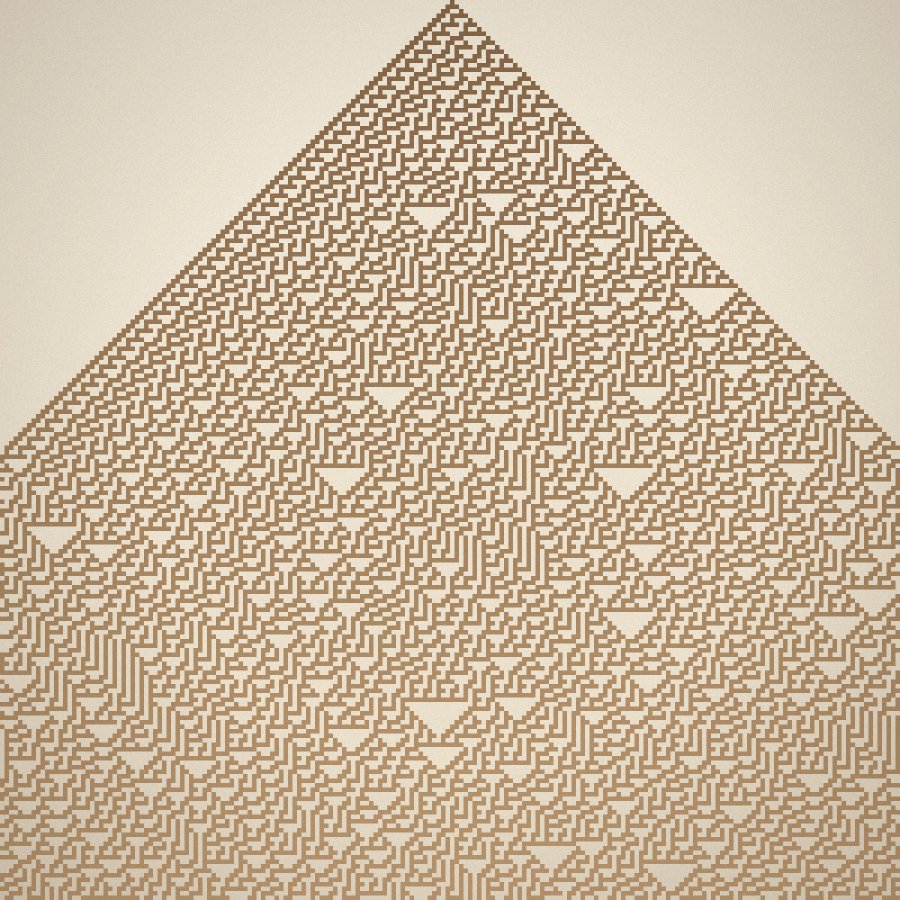
Stephen Wolfram later systematized this in A New Kind of Science (2002), demonstrating that even the simplest one-dimensional automata (a single row of cells, two possible states, one update rule) can produce behavior indistinguishable from randomness or generate stable, intricate structure. The insight: one does not need complicated rules to produce complicated results. Simple rules and enough iterations will do.
The key properties of cellular automata that matter here for my guitar practice (experiment):
Local rules, global pattern. Each cell only looks at its immediate neighbors. The large-scale structure is not designed; it is an emergent consequence of many local interactions.
Sensitivity to initial conditions. A different seed produces a completely different history. The starting point matters, not because it predicts the outcome, but because it is where iteration begins.
No terminus. A cellular automaton does not converge on a final state (except in degenerate cases). It runs. The pattern at generation 1,000 is no more "finished" than the pattern at generation 10.
This is an experiment in applying that paradigm, understood lyrically vs. mechanically, to my own guitar practice.
The Frame
What if I initialized my personal guitar practice like a cellular automaton? One fragment is the seed. A small set of operations are the rules. I apply them repeatedly and see what emerges. No curriculum. No master plan. No dependency on a teacher or persona. No predetermined destination. Just iteration on a single origin, and the willingness to follow wherever the mutations lead.
I don't know if this works yet. And, I only have a vague intuition about what "works" even means as it applies to my guitar journey. And so, this is the experiment, not the conclusion.
Principles
One seed. A cellular automaton begins with a single cell. I begin with a single fragment (but not a single note). Not two. Not a "balanced routine." One.
Simple rules, repeated. The operations are few. The richness comes from running them again and again, not from adding more rules.
Complexity is emergent. I don't plan my way to musical sophistication. I iterate my way there. Theory, technique, ear training: these enter when the iteration demands them, not before.
Honest state. A cellular automaton can't skip a generation. Neither can I. If a fragment takes effort, it's not ready to iterate. Stay with it.
Stop cleanly. A simulation run with corrupted cycles produces garbage. When focus degrades, stop. Five clean minutes beats two noisy hours.
Selecting a Seed
A seed is a concrete, specific, playable fragment. Not a concept ("learn Mixolydian"). Not an abstract skill ("improve alternate picking"). Something with actual notes in a specific order that I can attempt right now, even if badly.
What qualifies:
A lick I heard and something fired. A riff that made me stop and rewind. A picking pattern from a player I admire. A passage from a tune that I want inside my hands.
It should be a coherent phrase with a musical beginning and end. Two to four bars is the right size (see, e.g., Kenny Werner, Effortless Mastery). A complete musical thought, not a decontextualized scale exercise.
The phrase is the seed. But mastery happens inside it, note by note. Werner: "Achieve absolute mastery over the first note, then add the second note. Stay and wait for the two notes to flow. Those two notes should feel as if they are being played automatically before you add a third." The seed is not mastered until every note in the phrase flows seamlessly from beginning to end.
What doesn't qualify:
"Get better at sweeping." (Too abstract. Find a specific swept arpeggio passage.)
An entire solo. (Too large. Extract the four bars that grabbed me.)
Anything chosen out of obligation rather than resonance.
The Seed Heuristics
These are the starting operations. The initial and somewhat porous "rule" set for the automaton. They are not definitive; they are themselves a fragment, subject to iteration. Some may prove useless. Others I haven't thought of yet will emerge from practice. This is generation zero. Heuristics, guides, "rules":
Change the key. Move the fragment to a different position on the neck.Shift a note. Replace one note with an adjacent scale tone or chromatic neighbor.Displace the rhythm. Start the phrase on a different beat or subdivision.Change the tempo. Slow it down until it breathes differently, or push it until something breaks.Alter the context. Play it over a different chord, progression, or backing track.Reverse the contour. If it ascends, descend. If it leaps, step.Truncate or extend. Take the first three notes and loop them. Or add a note at the end and see where it wants to go.
Initialize the Experiment
Settings:
Practice getting started; then start practicing (h/t Kenny Werner)
20 mins per session
Memorization of seed
Iteration of seed and branching off into different inspired directions comes after memory installed
Time box: weekly as a starter constraint (on the one hand, to prevent both an open-ended perfectionist delusion, and on the other hand, to refrain from biting off too much, which is invariably my seduction)
Seed | Paganini Caprice No. 2 ending bars |
Source | Transcribed and interpreted by Anton Oparin |
Why this one | Time-tested, technical, structured harmony |
Starting state | New material |
Endnote
There is no final generation. Learn feeds Iterate. Iterate surfaces new seeds to Learn. The grid is not a curriculum with a finish line. It is a rule set that runs indefinitely, producing patterns of increasing complexity from irreducibly simple origins. Zoom into any cell and there is always more depth. That is not a deficiency. It is the point!