Project
N°004
Name
04 The Loop Opens
Location
Space
Year
2026
Type
Generation
Mode
Hypothesis
Author(s)
Sandeep Ramesh & Glider (SR's Guitar AI Agent)
SPEED READ. Gen 02 left two questions: what comes after memorizing the seed, and where the next seed comes from. The answer, borrowed from LoGsounds, is that practice runs in three phases. Mechanical: get the figure in my hands, then play it in every position on the neck. Exploration: mess with it. Application: play it over real music, which is the only place it sticks. Leave the first phase when the piece is in my hands, not when it's perfect. And the phases are a loop, not a line: messing around throws off figures worth keeping, and each one is the next seed. That is where new material comes from. My own playing, not a book. Inspired by LoG's playing and exceptional pedagogy (truly), I have iterated on my prior Werner-inspired practice Grid, creating a new Loop.
The first generation built the engine. The second planted a seed and left two open questions. The third took Werner's state protocol and named where it fell short.
Since instantiating this automata experiment, I have found myself stuck in the technical / mechanical drilling, neatly contained in the 20 minute structured practice session, recapped below:
The 20-Minute Session Grid
Mode | Minutes | Mode | Focus |
|---|---|---|---|
Settle | As long as needed | — | Breathe. Hands on instrument. No playing. |
Diamond Mode C | 0:00 to 5:00 | Diamond Mode C | Full seed, slow, note-perfect, effortless. Memorization priority. |
Diamond Mode B | 5:00 to 10:00 | Diamond Mode B | Chunks at tempo, zero errors, effortless. Speed on fragments. |
Heuristic rotation | 10:00 to 16:00 | Heuristic rotation | One transformation rule applied to the seed. Observe what emerges. |
Diamond Mode A | 16:00 to 20:00 | Diamond Mode A | Full seed at tempo, allow errors, effortless. Integration pass. |
75% of the 20-minute session is exclusively devoted to mechanics. And, I've experienced the brief 5-minutes allocated to "heuristic rotation" where technical focus gives space for some creative play and interpolation to itself become mechanical. Over the past 14 sessions, I defaulted to taking a chunk of Caprice 2 and running it in the various octaves.
System Redesign
The grid failed for one reason. It is all one phase in one container. Fifteen of the twenty minutes are mechanical by design, and the five for "heuristic rotation" collapsed into mechanics too. Fourteen sessions of Caprice chunks through octaves is not exploration. It is the positional half of the mechanical phase wearing the exploration slot's name. And I felt it. The feeling wasn't boredom so much as it was an internal grating, white-knuckling with my pick in hand. The creative "heuristic" slot sat inside a scored session, and next to a scoreboard the unscored thing always loses.
Moreover, the "heuristic" options were so numerous, that I lost to the overwhelm of positive optionality. In this next iteration, more constraints shall set me free.
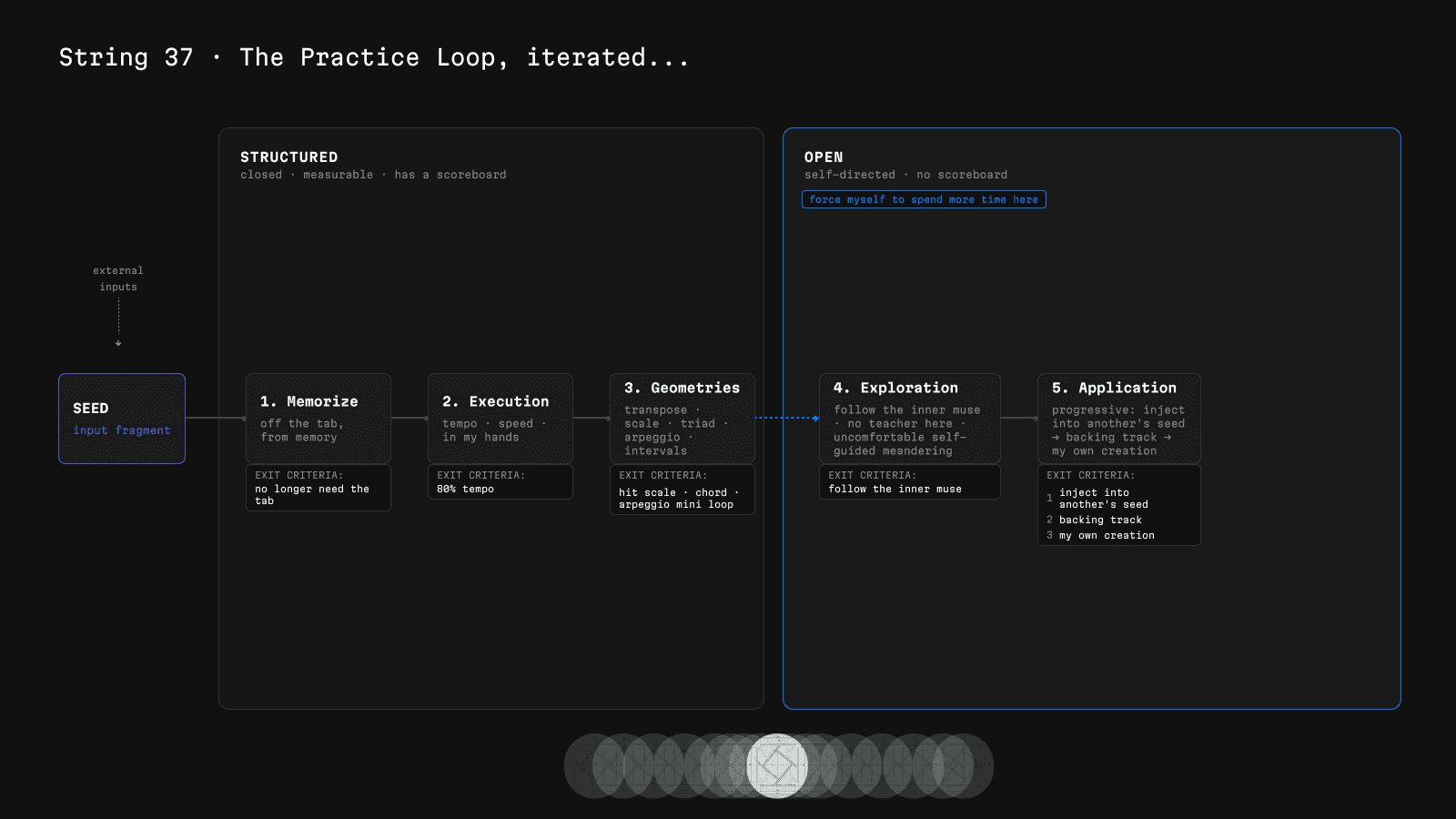
Ultimately, what does the next practice design iteration look like? The fix is not a better time split inside the session. It is separate sessions. The mechanical phase keeps structured sessions. Everything else gets open ones. Why that is the only thing that works comes straight from how the diamond modes move.
And so, here's how I'm visualizing this:
Implementation Specifics
No more planning. Let me go off screen and into (the) space. I will return, enriched by messy feedback.
