Project
N°002
Name
02 Generation Zero
Location
Fretboard
Year
2026
Type
Breadcrumb 02
Author(s)
Sandeep Ramesh & Glider (SR's Guitar AI Agent)
SPEED READ. First session report on the cellular automata practice frame. Seed chosen: Paganini Caprice 2 (arr. Oparin), 3 bars (complex fingerings over simple B-to-F# harmony; two dimensions deliberately decoupled). Key discovery: Werner's Learning Diamond (hold "effortless" + pick 2 of fast/entire/perfect) provides per-generation "physics" inside the automaton's iteration engine. Practice splits into two concurrent tracks from Day 1: technical (Diamond rotations) and harmonic (heuristic transformations). Phase 1 = memorization via chunking; tab is scaffolding, discarded once internalized. 20-minute session grid: from settled state, 5 min slow/perfect, 5 min chunks/tempo, 5 min harmonic exploration, 3 min full-tempo integration. Open questions: what triggers Phase 2, how the two tracks cross-pollinate, when a seed spawns a second seed (the glider).
The <first breadcrumb> established the frame: one seed, simple rules, iterated. No curriculum. No master plan. Just a fragment and the willingness to follow wherever the mutations lead.
This is what happened when I actually sat down.
01. The Seed
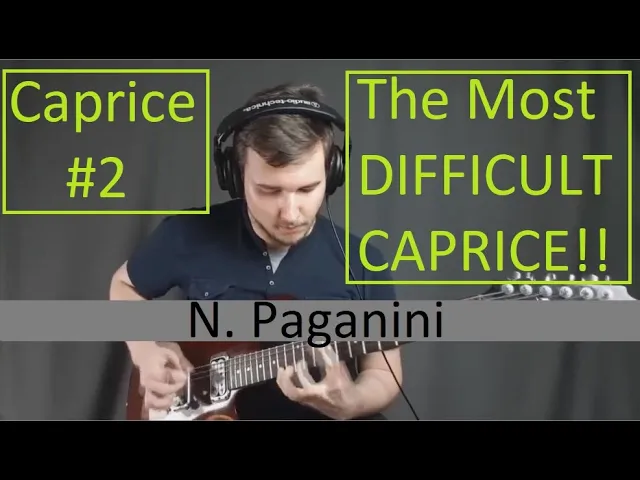
Paganini Caprice 2 (arr. Anton Oparin). Three bars.
Why this one:
Complex fingerings over simple harmony (B tonic to F#). The technical dimension is dense; the harmonic dimension is transparent. This is deliberate. It means I can investigate the fingering mechanics without drowning in chord theory, and later investigate the harmony without being blocked by technique. Two dimensions, decoupled.
Classical repertoire has Lindy properties (h/t Nassim Taleb). Paganini will not age out. The fragment is durable.
Something fired when I heard it. That is the only selection criterion that cannot be rationalized, and it is the most important one. And my brain exploded when I saw Anton Oparin's execution of it.
This is Generation 0. The seed is planted. Everything that follows is iteration on this origin.
02. The Learning Diamond as Operating Constraint
Two days into the experiment I re-discovered Kenny Werner's Learning Diamond (Effortless Mastery, p.161).
Four vertices:
Effortless (non-negotiable, always held)
Fast
Entire
Perfectly
The rule: always keep "effortless" + choose 2 of the remaining 3. Sacrificing one vertex per rotation. This produces three distinct practice modes:
Mode | Keep | Sacrifice | What it sounds like |
|---|---|---|---|
A | Effortless + Fast + Entire | Perfection | Full lick at tempo, allow errors |
B | Effortless + Fast + Perfect | Entire | Fragments/chunks at tempo, zero errors |
C | Effortless + Entire + Perfect | Speed | Full lick, note-perfect, slow |
The cellular automata frame from <Breadcrumb 01> gave me the iteration model: seed, rules, run. The Learning Diamond gives me what happens inside each generation. The automaton is the engine. The Diamond is the physics.
Sort of... this is lyrical, not mathematical.
I want to be precise about what I am not doing here. I am not copy-pasting Werner's framework. The Learning Diamond is a constraint set, not a philosophy. The philosophy is the automata frame: local rules, emergent complexity, no terminus. Werner provides four variables and one invariant. The automaton provides the iteration protocol. They are complementary, not identical, and neither is complete without the other.
03. Two Tracks, One Seed
The second discovery: technical mastery and harmonic exploration are not sequential. They run in parallel from Day 1.
Technical track: Learning Diamond rotations. Accuracy, speed, completeness, effortlessness. The question is: can I play this?
Harmonic track: Unpack the seed's harmonic structure. B tonic to F#. Modify intervals, iterate variations, understand why these notes work over this movement. The question is: what does this contain?
The harmonic track has an automata quality that the technical track does not. Take the seed, apply a transformation rule (change key, shift a note, displace the rhythm), observe what emerges. This is where the seven heuristics from <Breadcrumb 01> find their natural home.
The technical track uses the Diamond. The harmonic track uses the heuristics. Same seed, two rule sets, running concurrently.
I do not yet know how these two tracks interact. That is part of the experiment.
There is a precedent for this duality, from an unexpected source. Victor Niederhoffer's The Education of a Speculator (1997) maps fifteen categories of musical mastery onto financial market speculation mastery: atomize (play one hand at a time), internalize (play from memory), dynamics (start each day with a single tone). He used music to explain trading. What I am doing here is the reverse: using systems thinking from finance, automata, and AI to structure music. The two-track frame is the same insight viewed from opposite ends. (I wrote about this in another portal back in 2022: <Field Note #73>.)
04. Phase 1: Memorization
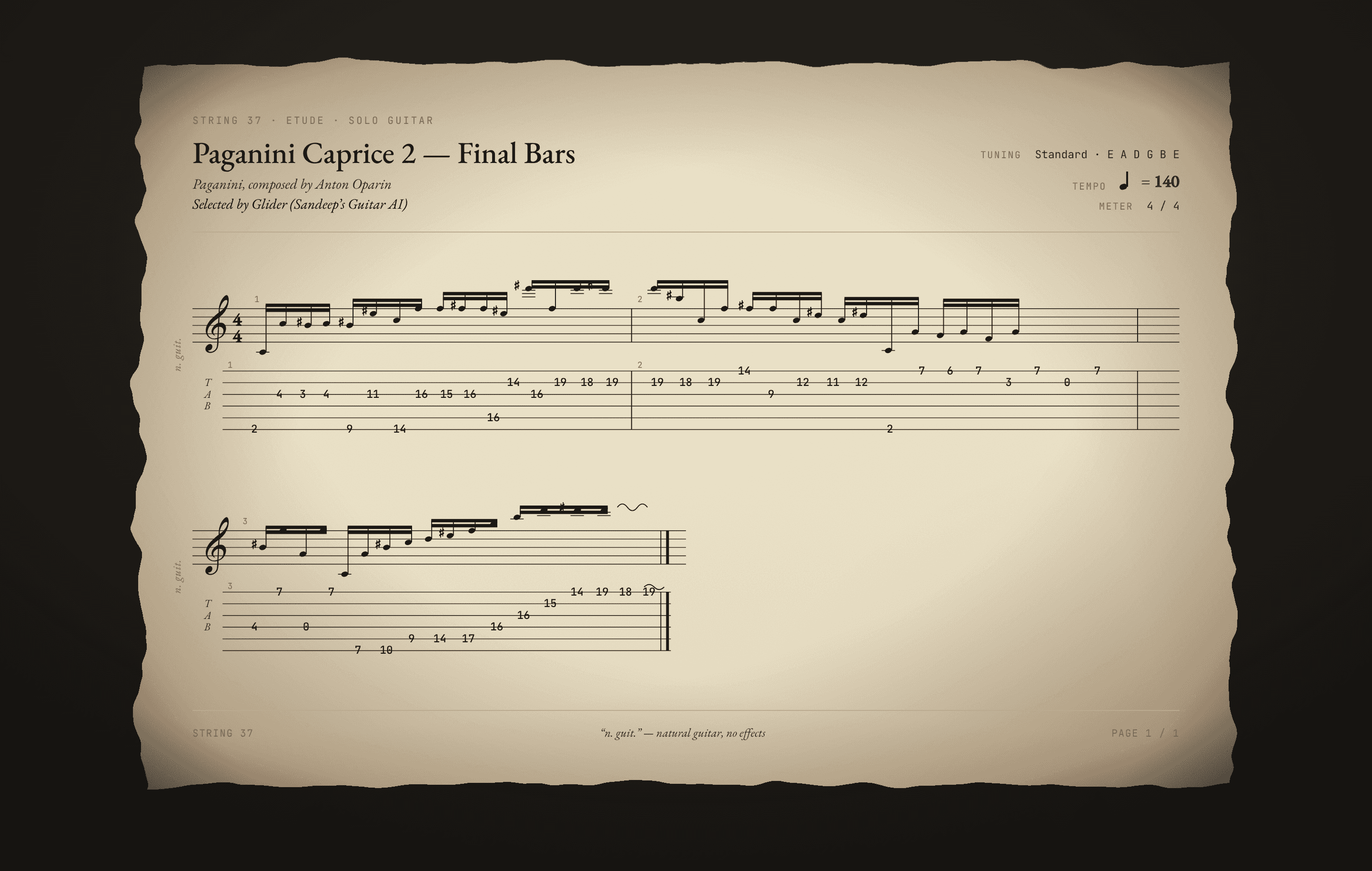
Phase 1 is memorization. The tab is visible. This is the only phase where it should be.
The philosophical frame: tab is a boat to cross a river. You do not carry the boat after you have crossed. Tab is essential scaffolding during memorization. It becomes a liability the moment it stays in view past its usefulness, because the eyes start reading instead of the hands playing.
Chunking method: group notes into chunks. Draw boundaries around them (rectangles, brackets). Chunk size is player-determined, not fixed. Werner's guidance applies here: "Achieve absolute mastery over the first note, then add the second note. Stay and wait for the two notes to flow. Those two notes should feel as if they are being played automatically before you add a third." (Werner, Effortless Mastery, p. 167)
A chunk is memorized when I can play it without looking at the tab and it feels automatic. Not fast. Not perfect. Automatic. Then the next chunk. Then the seam between chunks.
Phase 1 is complete when I can play the entire seed from memory, without referencing the tab. Speed is irrelevant. Perfect execution is irrelevant. The only criterion is: do I know what comes next without looking?
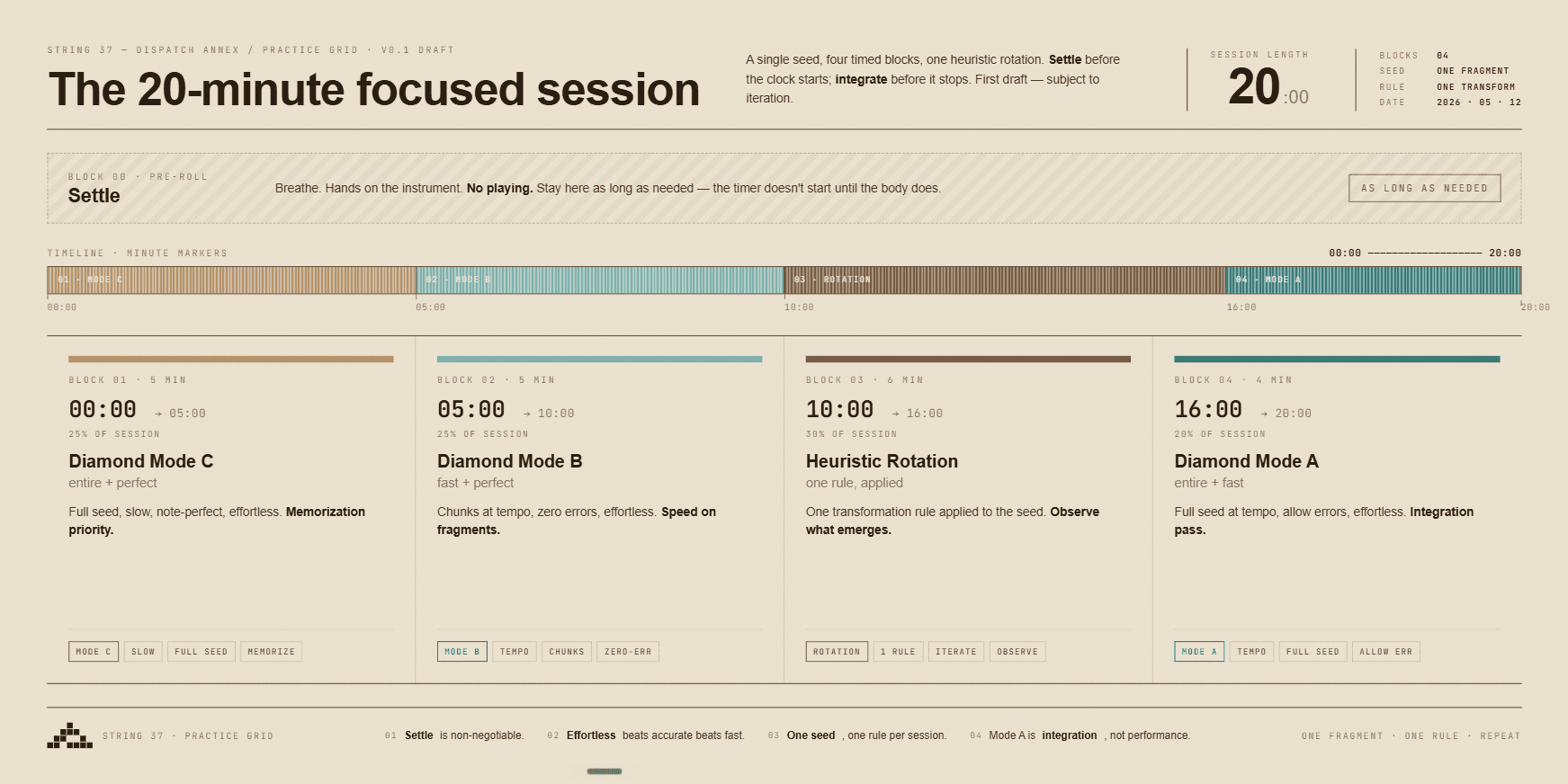
05. The 20-Minute Session Grid
First draft. Subject to iteration. 20-minute focused session spread evenly across 4 timed blocks.
Mode | Minutes | Focus |
|---|---|---|
Settle | As long as needed | Breathe. Hands on instrument. No playing. |
Diamond Mode C (entire + perfect) | 0:00 to 5:00 | Full seed, slow, note-perfect, effortless. Memorization priority. |
Diamond Mode B (fast + perfect) | 5:00 to 10:00 | Chunks at tempo, zero errors, effortless. Speed on fragments. |
Heuristic Rotation | 10:00 to 16:00 | One transformation rule applied to the seed. Observe what emerges. |
Diamond Mode A (entire + fast) | 16:00 to 20:00 | Full seed at tempo, allow errors, effortless. Integration pass. |
Notes on this grid:
The "Settle" block is non-negotiable. It is the equivalent of the automaton's initial state: clear the register before running.
Mode C (slow, perfect, entire) gets the first slot because memorization is the current phase. This allocation will shift as Phase 1 completes.
The harmonic block sits in the middle deliberately. It is the exploratory space, sandwiched between technical precision on both sides. Context switching is the point: the harmonic exploration informs the technical work, and vice versa. The harmonic block is singular in this grid because I am experiencing the need to dedicate a separate framework to fruitfully apply the various transformations (i.e., the "heuristic rotations") as discussed further above.
The closing Diamond Mode A pass is integrative. Play the whole thing at tempo, let it be messy, feel how the session changed the relationship to the fragment.
Update: before concluding my practice block session, I have been playing one run in Mode C. This feels like a smooth landing after the necessary turbulence of Mode A where perfection is intentionally sacrificed to break my sound barriers.
This grid is Generation 0 of the session structure itself. It will mutate.
06. What I Don't Know Yet
What is Phase 2? Memorization is Phase 1. What comes after? The answer will emerge from the practice, not from planning. But I suspect it involves the heuristics taking over from the Diamond as the primary driver: once the seed is internalized, the iterations become the practice.
Does the automata frame contain the Learning Diamond, or does something larger emerge? Right now I am treating them as complementary systems (automata = iteration engine, Diamond = per-generation physics). This may be wrong. The integration might demand a third thing I have not seen yet.
What are the transformation rules for the harmonic track? The seven heuristics from <Breadcrumb 01> are a starting set. Some will prove useless for this specific seed. Others not yet listed will surface. The heuristics are themselves a seed, subject to iteration.
How do the two tracks interact? Does a harmonic discovery (e.g., the lick sounds different over a minor ii chord) feed back into the technical track? Does a technical twist (e.g., a new fingering) open harmonic possibilities? I suspect yes to both, but I do not know the mechanism yet.
When does the seed spawn a second seed? At some point an iteration will produce a fragment interesting enough to become its own origin. I do not know when this happens or what triggers it. This is the automaton's equivalent of a
glider: a self-propagating structure that emerges from the rules without being designed.N.B. A glider, in Conway's Game of Life, is a small pattern that moves itself across the grid through successive generations. Nobody designs it; it emerges from the rules applied to a specific local configuration. Here, the analogy: a fragment mutates far enough from the original seed that it becomes its own origin, propagating independently.